


1998 Started the tea export businese - We, Friends Tea Co., Ltd. stands in Ningbo City, Zhejiang Province, China, specializes in exporting China tea to all over the world.
-
![Jasmine Dragon Pearl Tea]() Jasmine Dragon Pearl TeaJasmine Dragon pearl tea is a kind of Jasmine green tea, also be named as "Jasmine Dragon Ball tea", "Jasmine Yu Luo Tea", "Jasmine Qu Luo tea", etc. All these name come from its shape. From this...read more
Jasmine Dragon Pearl TeaJasmine Dragon pearl tea is a kind of Jasmine green tea, also be named as "Jasmine Dragon Ball tea", "Jasmine Yu Luo Tea", "Jasmine Qu Luo tea", etc. All these name come from its shape. From this...read more -
![Jasmine Dragon Ball Tea]() Jasmine Dragon Ball TeaJasmine Dragon ball tea is high quality Jasmine green tea, also be named as "Jasmine Dragon pearl tea", "Jasmine Yu Luo Tea", "Jasmine Qu Luo tea", etc.read more
Jasmine Dragon Ball TeaJasmine Dragon ball tea is high quality Jasmine green tea, also be named as "Jasmine Dragon pearl tea", "Jasmine Yu Luo Tea", "Jasmine Qu Luo tea", etc.read more -
![Organic Jasmine Tea]() Organic Jasmine TeaThese years for meeting the European tea market demands, we start to produce organic jasmine tea, we always select some high quality organic green tea, mixed with the finest organic fresh jasmine...read more
Organic Jasmine TeaThese years for meeting the European tea market demands, we start to produce organic jasmine tea, we always select some high quality organic green tea, mixed with the finest organic fresh jasmine...read more -
![Jasmine Quhao Tea]() Jasmine Quhao TeaAccording to the shape of the basic tea leaves, the Jasmine tea can be classed as spiral shape, cord shape, needle shape, leaf pearl shape, bud pearl shape, ring shape, and the wheat ear shape.read more
Jasmine Quhao TeaAccording to the shape of the basic tea leaves, the Jasmine tea can be classed as spiral shape, cord shape, needle shape, leaf pearl shape, bud pearl shape, ring shape, and the wheat ear shape.read more -
![Jasmine Xiang Luo Tea]() Jasmine Xiang Luo TeaWe supply a large number of Jasmine Xiang Luo tea every year, which is a kind of Spiral shape jasmine tea, we select some good quality spiral shape green tea as the basic tea, mixed with some...read more
Jasmine Xiang Luo TeaWe supply a large number of Jasmine Xiang Luo tea every year, which is a kind of Spiral shape jasmine tea, we select some good quality spiral shape green tea as the basic tea, mixed with some...read more -
![Jasmine Maofeng Tea]() Jasmine Maofeng TeaThe Jasmine Maofeng tea is our main jasmine green tea product, we choice the good quality early spring basket-fired Maofeng green tea as the basic tea, after a traditional processing of six times...read more
Jasmine Maofeng TeaThe Jasmine Maofeng tea is our main jasmine green tea product, we choice the good quality early spring basket-fired Maofeng green tea as the basic tea, after a traditional processing of six times...read more -
![Jasmine Maojian Tea]() Jasmine Maojian TeaThe Jasmine Maojian tea is a kind of classical Chinese jasmine green tea, is widely popular because of its special jasmine fragrance and strong tea taste. We choice high quality Maojian green tea...read more
Jasmine Maojian TeaThe Jasmine Maojian tea is a kind of classical Chinese jasmine green tea, is widely popular because of its special jasmine fragrance and strong tea taste. We choice high quality Maojian green tea...read more -
![Jasmine Aroma Tea]() Jasmine Aroma TeaThe Jasmine aroma tea is also named as Jasmine green tea, which is our large number quantity bulk jasmine loose tea, the tea leaves is not so tender and tight, the color is black, have some tea...read more
Jasmine Aroma TeaThe Jasmine aroma tea is also named as Jasmine green tea, which is our large number quantity bulk jasmine loose tea, the tea leaves is not so tender and tight, the color is black, have some tea...read more -
![Jasmine Gunpowder Tea]() Jasmine Gunpowder TeaJasmine gunpowder green tea is a new developed jasmine tea by us in recent years, which is a kind of cheap price jasmine tea for the middle Asia countries and Russia market, like the Uzbekistan,...read more
Jasmine Gunpowder TeaJasmine gunpowder green tea is a new developed jasmine tea by us in recent years, which is a kind of cheap price jasmine tea for the middle Asia countries and Russia market, like the Uzbekistan,...read more -
![Jasmine Green Tea]() Jasmine Green TeaIn recent years, our jasmine green tea is really welcome by international tea markets. We select clean, large and loose leaf, basket-fired green tea as basic tea, mixed with the dry scented...read more
Jasmine Green TeaIn recent years, our jasmine green tea is really welcome by international tea markets. We select clean, large and loose leaf, basket-fired green tea as basic tea, mixed with the dry scented...read more


Why choose us?
Specialize in the green tea exported
Ningbo Fengyu Tea Co., Ltd., founded in 2015, specialize in the green tea exported to Islamic regions, such as Afghanistan, Morocco, Mauritania, Mali, Niger and so on.
We can design your own brand
We always help our new buyers to design their own brand because we know well what kind of tea boxes, colors and way of packing are popular in their market.
We always ship the goods in due time
In fact, we always try to do more than your requirements. Most of our delivery time is 15-20 days after the order is confirmed.
Provide you with the most competitive price
We always try our best to give you the most competitive price, and control the shipment quality matching the contract sample.
What is Chinese Jasmine Tea?
Chinese Jasmine Tea is any tea that has been scented or fragranced with the smell of Jasmine flowers. You can find examples of jasmine tea from white to black, but white and green teas are mostly commonly associated with this process. There many ways in which the tea can be married with jasmine and it can be done artificially, which is common, or more authentically through a natural process. The former renders an inconsistent and 'fake' taste which is nowhere near as pleasing as the latter.
Chinese Jasmine Tea are fragranced naturally by only using whole, fresh jasmine flowers. The process is laborious but well worth the effort. Our teas are picked in early spring and, if they are to be scented, packed and kept airtight in a cool environment. When jasmine comes into full bloom in the summer in the neighbouring province of Guangxi, the flowers are picked early in the day. When night comes the flower opens fully and they are laid to layer with the tea leaves where the intense and wonderful scent can be imparted and bound with the leaf. By morning, the process must be started all over again and this will happen for up to five consecutive nights as the jasmine flower only lasts for 24-hrs once picked. It's a labour of love well worth it for the results.
Advantages of Chinese Jasmine Tea
Pain-relieving
The volatile oily substances in jasmine tea can help you relieve the thoracoabdominal swelling pain, making your body at ease.
Antisepsis and Ati-inflammation
Jasmine tea can inhibit many kinds of bacteria. If you drink it and apply it to the inflamed area, you can get recovered from pinkeye, sore and ulcer and skin ulceration.
Beauty Effect
For ladies, developing the habit of having Chinese jasmine tea can help resist aging and the relative problems such as facial dehydration and blemished skin to keep the skin clean, white, soft and tender.
Cancer-preventing
On top of tea polyphenols and tea pigments, tea also contains selenium, molybdenum, manganese, germanium etc. which can help in preventing cancer caused by the insuffiency of manganese and redundancy of copper in potable water. Jasmine green tea has been proved to reduce risks of breast cancer, lung cancer, and many other diseases.
Tiredness-allaying
Theine in tea can stimulate the central nervous system and play as a role in driving off drowsiness, eliminating fatigue, enhancing vitality and concentrating thinking.
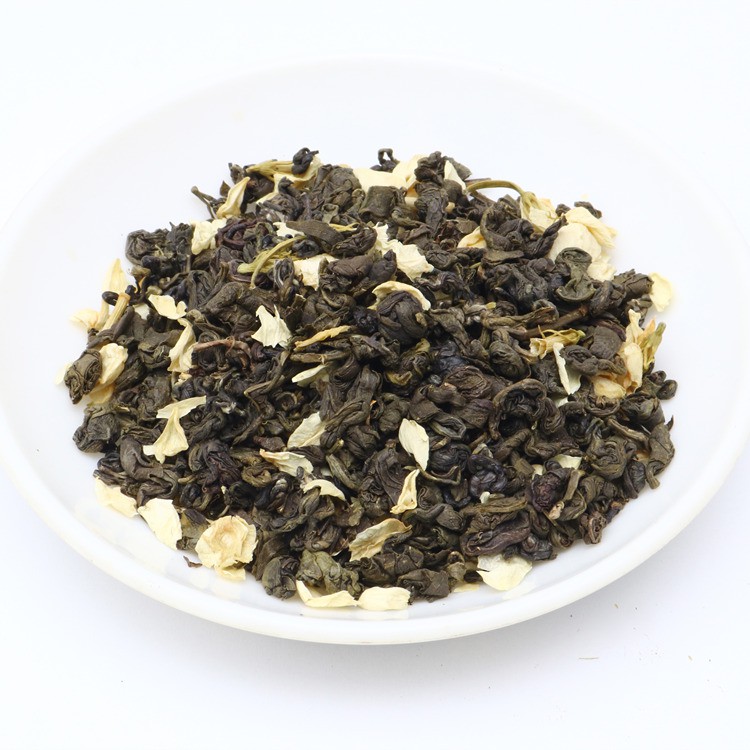
Light and refreshing with a hint of nature’s perfume, jasmine tea is a special blend admired as much for its fragrance as for its taste. This unique blend is made by scenting tea leaves with fragrant jasmine flowers under very specific conditions to bring out a perfect marriage of scent and flavor notes in the resulting tea. Jasmine green tea is the most popular variety, though the flowers may also be added to black, white and oolong teas, or simply combined with other botanicals to make an herbal tisane.
Scenting tea with jasmine is a centuries-old practice requiring a remarkable amount of skill, patience and craftsmanship. Chinese tea growers are only able to create this delicate and complex tea for a few months out of the year, when the weather is warm and the jasmine fields are in bloom. Harvesting thousands of tiny, perfectly-poised buds is a feat of remarkable dexterity and concentration, and the labor-intensive process requires precise timing.
Each evening in June, July and August, jasmine buds are hand-plucked in the early afternoon, when the sun is out and the morning dew has evaporated. Pickers are careful to select only buds that appear to be on the verge of blooming that evening. Once plucked, the flowers are then stored in a scenting house, placed in alternating layers with tea leaves until the cool night air can coax the blossom's intoxicating scent into the air. As the jasmine buds unfurl, their fragrance is released and the tea absorbs the essence of jasmine, creating an exquisite blend.
The quality of Chinese Jasmine Tea is determined by both the tea leaves used as its base and the effectiveness of the scenting process. High-grade teas require the process to be repeated as many as seven times.
Jasmine Tea and Caffeine
It is quite difficult to determine the exact amount of caffeine in any tea type on the whole without testing every single batch that is produced, as there are so many variables that will ultimately have implications for the result, such as the time at which it was picked, what the weather has been like during growth and how it was processed. The amount of caffeine in a Jasmine tea will vary also between whether it is a white, green or black tea. Needless to say, however, that the caffeine in tea as a beverage is far lower than that of a cup of coffee. What's more, an amino acid in tea - theanine - helps to slow the absorption of caffeine in the blood and so uplifts you gently, rather than give you the spike associated with coffee.
Dry Fresh Tea Leaves
They should be dried with fire between 100~120℃ to remove the stale flavor and excessive water.
Pick Jasmine Flowers
There is a strict rule to pick jasmine flowers used to make jasmine tea. Jasmine bud that has double petals in the hot summer is the best. Rain-swept jasmine couldn’t be picked until the weather goes fine 1~2 days later. The best picking time is after 2 pm.
Mix the Tea Leaves and Jasmine Flowers
It should be down when both tea leaves and jasmine flowers are at normal temperatures. Lay one layer of tea leaves and one layer of jasmine flowers until several layers and then stir them well.
Stack the Mixture to Unify the Fragrance
As the time passing by, the tea leaves gradually absorb the pleasant fragrance given off by jasmine flowers.
Flat the Mixure, Pick out the Jasmine Flowers and Dry the Tea Leaves
This is because the tea leaves get moist after stacking.
Repeat Step 3 and 4 for Several Times
This aims to enhance and unify the fragrance of tea leaves.
Dry the Mixture Well for Longer Storage
Some Chinese jasmine tea has no flowers inside because they are moved before the last step.
Chinese Jasmine Tea - Tea Sommelier's Tips
Jasmine tea can be had without any sugar and/or milk or just plain, without anything added.
Use good quality water.
Tea is mostly water so it's important to use good quality water. I recommend using filtered water.
Use an electric kettle with temperature setting.
Heating water in an electric kettle with a temperature setting is the best way to get the correct the water temperature for jasmine tea. Set the kettle to 175°F. (If you're making jasmine pearl tea, you can use a higher water temperature. Check the tea package for correct water temperature for your tea.)
Loose tea is higher quality tea.
The bigger the tea pieces are, the better the quality and generally, loose tea is the highest quality. Tea bags usually contain tiny, broken leaves that increase the tea's bitterness. If loose tea isn't available, tea sachets are the next best choice since they contain tea leaves that are more intact. (See tea comparison photos.)
Don't make green tea with boiling hot water.
Green tea should be made with simmered water, not boiling hot. Using water that's too hot will make the tea bitter.
Don't brew green tea for too long.
Jasmine tea is usually made with green tea which shouldn't be brewed for longer than 3 minutes. Brewing for too long or in water that’s too hot is how you get really bitter jasmine tea.
Warm the teapot.
Tea professionals always warm the teapot before making tea to make sure keep the temperature is stable while the tea steeps. Don't forget to add some extra water to the kettle so that you can warm up the teapot!
Store it properly.
Brewed jasmine tea can be kept in the refrigerator, covered, for up to 4 days.
Loose jasmine tea leaves should stored in an airtight container kept away from light, odor, humidity, and heat.
So you've heard that Jasmine tea is delicious, but when you tried it out yourself, it may not be what you expected. Don't worry, that's actually what we often hear from people who made their Jasmine tea the first time.
Now there are two ways to approach this. The first way is to tweak your preparation method and the second way is to add sweeteners. We always recommend tea lovers to try out the first method, so let's get started.
How To Make Jasmine Tea Not Bitter
There are several reasons why your Jasmine tea ended up bitter. It's important to understand this first, before we try to solve the problem. Here are basically the main reasons:
You used too much tea.
You applied water at a too high temperature.
You let it steep for too long.
You got mediocre quality Jasmine tea.
You're not drinking Jasmine tea at the right temperature.
How Much Jasmine Tea Per Cup?
Generally one needs around 2-5 grams of Jasmine tea per cup. The exact amount will depend on individual characteristics of the tea and ones own preferences of the intensity. As a rule of thumb, we recommend to start with 3 gram if you want to brew a mug of tea or 5 gram if you want to prepare tea the traditional way (in a small gaiwan).
Note: If you're using a Jasmine tea bag, then obviously the amount isn't the problem. You'll learn more about applying the right temperature and steeping time in the below sections.
Temperature
Because Jasmine tea is generally made using either green or white tea, we recommend to apply a lower temperature of 80-85ºC (175 – 185 ºF) to steep the tea. This will in any circumstances give the best result and bring up the natural sweetness of Jasmine tea.
Steeping Jasmine tea at full temperature will always end up bitter or too astringent. So even if it's stated on the packaging of the vendor. Ignore it.
If you have some good quality loose leaf jasmine tea or even very delicate tea buds, then you'll be sipping very delicious sweet Jasmine tea. Now for tea bags this may still not solve the problem. If that's the case, lower the temperature even further and see if that works. Lower temperatures draws out more sweetness and less of the bitter stuff that's in the tea.
Steeping time
Steeping time for jasmine tea is the hardest to get right. That's because this will depend on the Jasmine tea in question. Crushed Jasmine tea in a tea bag will release flavour much faster than young Jasmine tea buds.
For tea bags, follow the instructions of the vendor, while applying our temperature suggestions above. Then adjust to get the intensity right.
For loose leaf teas that are either whole leaf or buds go for a steeping time of 3 minutes and then adjust according to taste. With traditional brewing, try a steeping time of 25 seconds.
Note: If you've tightly rolled teas such as a Jasmine pearls tea or Jasmine rings, you may need to increase the steeping a little, as those teas need time to unfurl and release taste.
Tea Quality
As mentioned before low grade tea quality can result in bitter brews. That’s because crushed or broken leaves releases too much bitterness, fully covering the natural sweetness that good jasmine tea can bring. The only thing you can do is to lower the temperature further, while compensation this with additional steeping time. When you get the right balance of lower temperature and longer steeping time right, it may work. If not, move on, and get better tea!
Drinking Temperature
To drink a sweeter tea, you need to consume it at the right temperature. We've made the mistake before of consuming tea too fast, while burning the roof of our mouth. The ideal temperature of consuming tea is 55ºC (130 ºF). If you’re brewing tea in a mug, then it will take several minutes to reach this temperature.
With traditional brewing, tea is served in small single sip cups. The benefit of those cups is that tea cools down in a matter seconds.
How to make jasmine tea sweet
While the above tips and tricks will definitely make your Jasmine tea not bitter, or even naturally sweet, it obviously will never be as sweet as a milkshake or bubble tea. For that, you'll have to add sweeteners. Here's a few things you can do.
Add milk: Milk is naturally sweet and by adding milk, you can enjoy a classic tea latte.
Add sweeteners: White sugar or rock sugar are the best options. Avoid honey, this doesn't go so well with the floral aroma of jasmine tea.
Add sweet tapioca pearls: These pearls are made with sticky rice and brown sugar. Besides additional sweetness, it gives your tea some extra sticky texture. Together with milk, you're basically enjoying a classic Taiwanese pearl bubble tea.
Our Factory
We get in touch the tea study from 1994, we contact the green tea processing and exporting since 1998, and we're known as Friends Tea Co., Ltd. since 2000, then we registered as Ningbo Fengyu Tea Co., Ltd. and obtained the exporting tea permit at the end of 2015.

FAQ
We're professional chinese jasmine tea suppliers, specialized in providing high quality products and service. We warmly welcome you to buy bulk chinese jasmine tea in stock here from our factory. For price consultation, contact us.
Jasmine Green Tea, Jasmine Quhao Tea, Jasmine Maofeng Tea